From Grass to Hard Court: How Tennis Surfaces Took Shape
Tennis court surfaces shape a court’s look and play. Compare grass, clay, and hard courts by materials, maintenance needs, and fit for your venue.
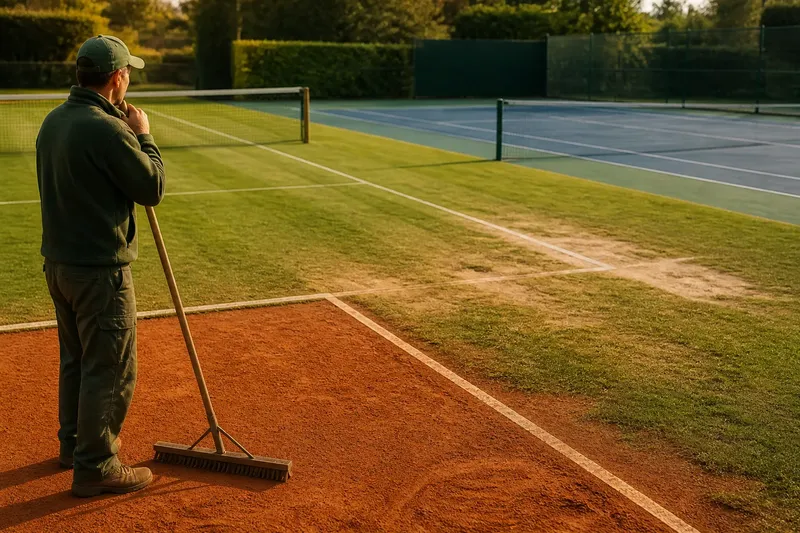
A groundskeeper pauses with a rake beside a clay court, while a few steps away a grass court shows the day’s foot traffic. Tennis court surfaces make their differences visible before a ball is served. Grass, clay, and hard courts each reflect a distinct way of building, maintaining, and using a place to play.
Their appearance follows practical choices: available materials, upkeep capacity, site conditions, and the kind of movement players prefer. Those choices also shape how the ball and players respond, though no surface name tells the whole story.
Why did tennis move beyond grass?
Early lawn tennis borrowed its setting from lawn sports: play on a carefully kept, level patch of turf. Grass offered a living surface, but it required mowing, rolling, watering, and repair. Foot traffic wore it unevenly, and weather could quickly change its condition.
As tennis spread beyond grounds that could support intensive turf care, builders adapted other familiar materials. Crushed brick, stone, and other mineral aggregates could form a compact playing bed. Paved systems later offered a more uniform base in places where maintaining a lawn was impractical.
This was not a neat progression in which each new surface replaced the last. Grass remained desirable where its upkeep and seasonal limits suited the venue. Clay and hard courts made different compromises, shaping both the court’s appearance and the way players move.
What makes grass, clay, and hard courts look different?
Grass is a living playing surface
Grass courts use turf grown over a prepared base and kept short enough for play. The green surface and clear lines can look orderly, but wear may expose soil or leave patchy areas. Court staff tend both a playing surface and a lawn, with weather and play affecting the same living material.
Grass changes with growth and maintenance. Wear along common paths is visible, and the court’s condition depends on the season. That variability is part of the tradition, not a decorative accident.
Clay is a layered bed of mineral material
“Clay court” is a broad label, not a promise that every court consists of the same soil. Many courts use compacted layers of stone or brick material topped with a fine, loose dressing. Red and green versions are familiar; their color reflects the materials used and local court traditions.
Players’ footwork leaves marks in the top layer. Court staff rake and redistribute the dressing to restore a more even playing area. Lines may be made from contrasting material set into the court, keeping them visible among the loose particles.
Hard courts pair a paved base with a playing finish
Hard courts typically begin with a firm base, such as asphalt or concrete, and receive a textured coating. The colored finish can make a court look crisp and graphic, with clear lines and broad blocks of color. Coatings and base systems vary, even when courts look similar.
A paved surface avoids the routine grooming associated with turf or loose mineral dressing, but it still needs attention. Wear, cracks, drainage, and coating condition affect both appearance and usability.
How does each surface change the playing space?
Grass is associated with a low, sometimes uneven bounce and a surface that can feel quick underfoot. Clay often gives the ball more time in play and invites sliding. Hard courts tend to present a more consistent-looking plane, though play characteristics depend on the particular system and its condition.
These are tendencies, not fixed promises. Court preparation, weather, wear, and construction all matter. A player choosing a club should pay attention to the actual court rather than assume every surface with a familiar name behaves identically.
The visual character changes the spectator’s view, too. Grass frames a match with a continuous green field; clay makes movement legible through tracks and swept areas; a hard court’s color blocks and lines give the playing zone graphic clarity. Each surface shows its maintenance in a different way.
Which tennis court surface suits your setting?
Grass tends to suit venues with the groundskeeping capacity, climate, and seasonal schedule to care for turf. It may appeal to players who enjoy a traditional lawn setting and accept that its condition depends on living growth and regular attention.
Clay may suit clubs that value a surface whose top dressing can be redistributed during grooming. It requires its own maintenance routine, including care for the playing bed and lines, and may not fit a venue without staff or time for that work.
Hard courts can suit shared facilities seeking a paved, clearly marked surface for varied use. The construction and finish must fit the site. A worn or damaged court may need professional assessment rather than a cosmetic patch.
Say a small community club has an existing paved area, limited groundskeeping time, and players who want court access through much of the year. The club’s starting conditions point toward considering a hard-court system: the expected result is a clearly bounded playing space with less routine grooming than turf, while staff still need to inspect wear and drainage. If the base proves unsuitable or drainage is unclear, the decision is to pause and seek a qualified court professional’s assessment before choosing a system; if staff can support clay grooming and players prefer sliding play, clay becomes a reasonable alternative to consider.
For materials, coatings, construction, and local restrictions, follow supplier specifications and applicable local rules. Ask a qualified court professional to assess the base or drainage when those conditions are uncertain.
What should you ask when choosing tennis court surfaces?
How much routine care can the venue provide?
Check who can handle mowing and turf repair, clay grooming, or inspection of a paved finish. If the venue has staff and time for the selected surface’s routine work, proceed with it as a candidate; if not, compare a surface that fits the available skills and schedule.
What does the site already support?
Check the existing base, drainage, weather exposure, and space for maintenance equipment. If the base and drainage suit a proposed system, keep it under consideration; if either is uncertain, seek a qualified assessment before selecting or installing a surface.
How do local players want to move?
Ask whether players prefer the footwork associated with grass, the sliding and marked movement of clay, or a firm paved court. If one preference is shared, prioritize that surface in the comparison; if preferences differ, consider access to more than one surface or choose the option that best serves the broader group.
Can the court’s appearance be kept in good order?
Check for turf wear, scattered clay dressing, or fading and cracks in a paved coating. If staff can address the visible upkeep required, retain the surface as an option; if not, favor one whose maintenance can be handled consistently.
- Check whether the venue has staff for mowing and turf repair; if it does, keep grass in consideration, and if it does not, compare clay or hard court systems instead.
- Check whether staff can rake and redistribute clay dressing; if they can, clay remains a candidate, and if they cannot, consider a surface with a different routine.
- Check the paved court for visible cracks or coating wear; if the base appears sound, request a system assessment, and if damage is present, seek professional advice before planning a finish.
- Check whether drainage is clear and understood; if it is, continue comparing suitable systems, and if it is uncertain, pause for a qualified assessment.
- Check whether maintenance equipment can be stored and used at the site; if it can, retain the surfaces that need it, and if it cannot, favor an option compatible with available space.
- Check which footwork players prefer; if preferences align, prioritize that surface, and if they differ, compare access to multiple surfaces against the venue’s care capacity.
How can a club choose without chasing tradition?
Start with the site and its caretakers, then weigh player preference. Grass, clay, and hard courts each carry a recognizable look because each asks for a different relationship between materials, weather, and upkeep. Choosing by reputation alone can leave a club with maintenance it cannot support.
For a facility comparing tennis court surfaces, the useful question is not which one is best in the abstract. It is which construction tradition the venue can maintain and which playing space its community wants to use. Before committing, confirm that the base, drainage, and planned care routine fit the chosen system; that check is less glamorous than picking a color, but more useful.